A Muay Thai Reality

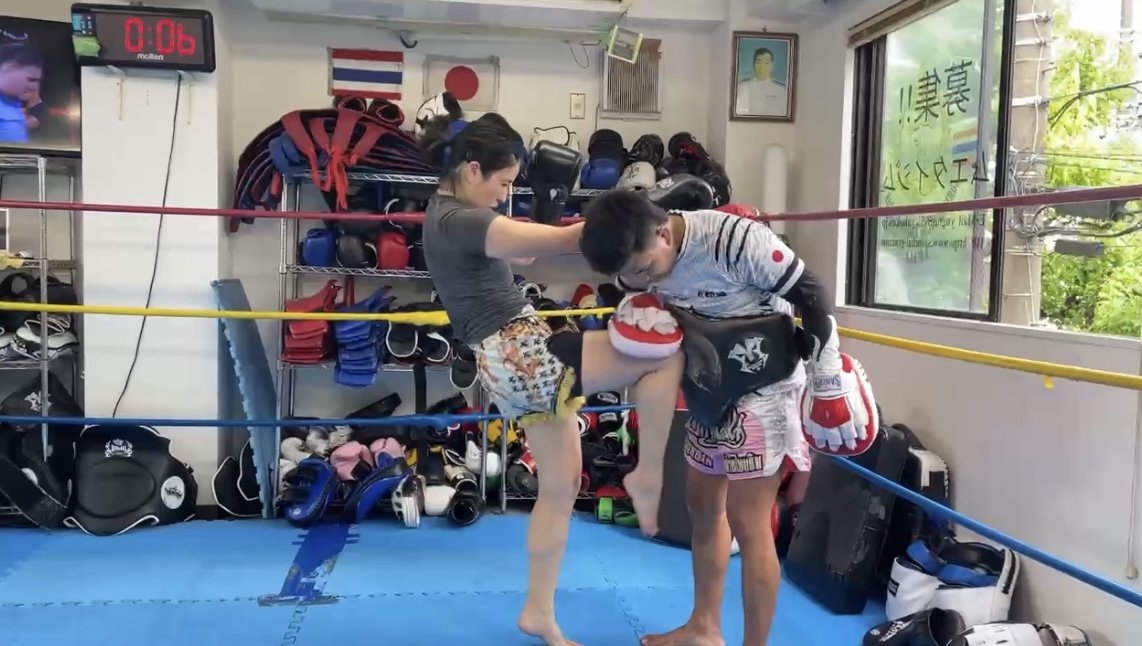
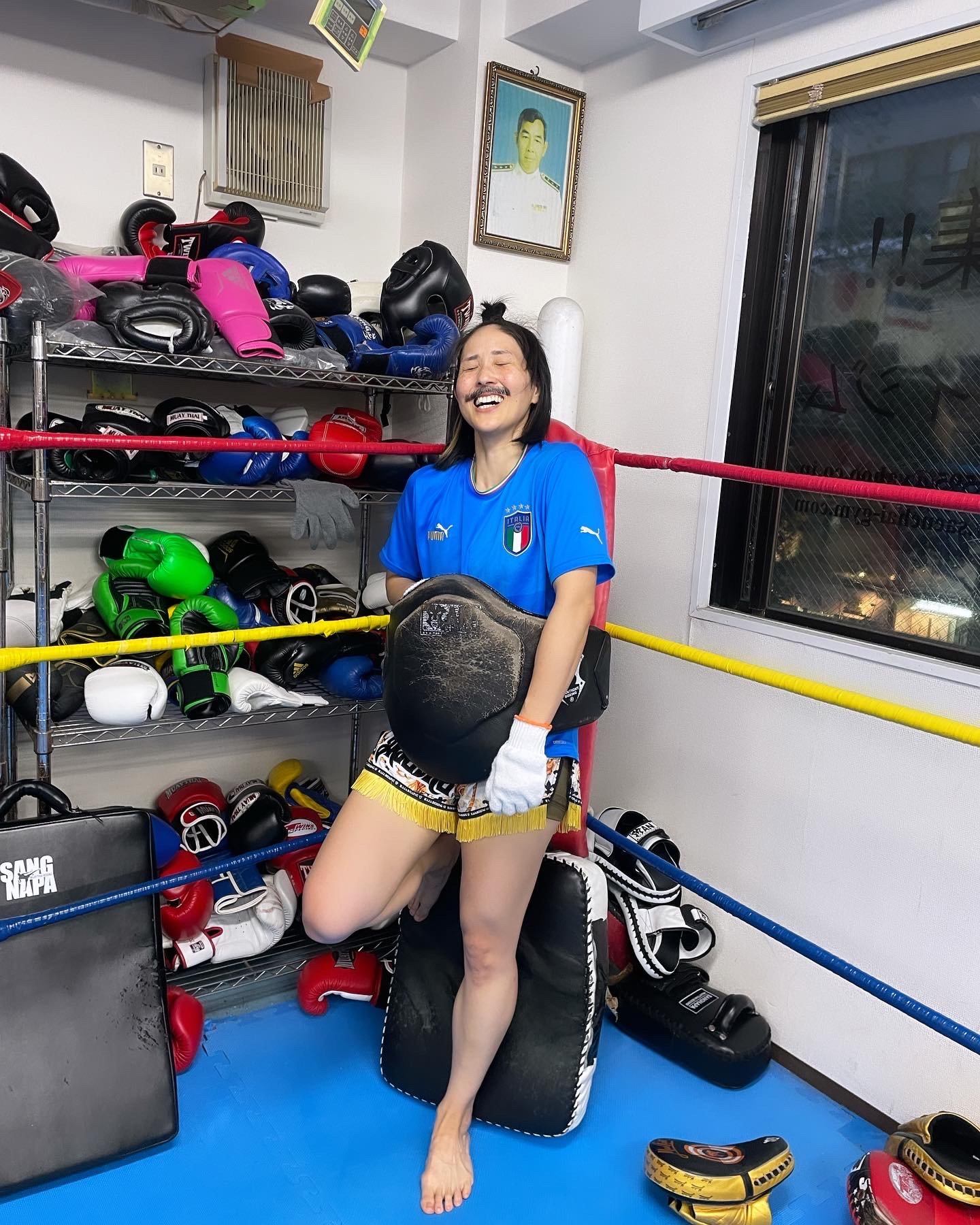
A few Saturdays ago, I was curled up in a corner, gasping for breath as I got lightly tapped on the top of my head, arms, sides, then took a knee to the stomach. “TKO,” the attacker said triumphantly, “TKO! TKOTKOTKO!” I managed to emit a strangled wail as the assault continued, finally ending with me laughing at my own ineptitude as I was tossed aside after a final knee tap to the liver. Two minutes and thirty-eight seconds left.

In early May, I had the idea that I should try something new. Brazilian Jiu-Jitsu seemed appealing enough to require research into local gyms, until a best friend showed me an article on Mark Zuckerberg’s love for the sport. I looked into Muay Thai and called a gym recommended on Reddit, conveniently only a train stop away.

“Do you offer trial lessons?” I said.

“Yes, when are you coming,” the woman on the other end demanded.

“Um, this Saturday?”

“Ok, what time.”

“Uh…noon?”

“Ok, see you then.”

I hung up, now obliged to actually follow through. A crushing fear of disappointing people I didn’t yet know and somehow developing a reputation for unreliability led me to a Muay Thai gym that Saturday. It was a small space; sparse and utilitarian in the way you’d expect a serious gym to be. There were two heavy bags, a small ring, and shelving piled high with strike pads, gloves, shin pads, and belly pads. Over the course of the next 90 minutes, I learned that keeping my upper arms parallel to the ground for more than 20 seconds can be excruciating. I also almost died about ten times.

You hear it all the time – “it got me in the best shape of my life” – and usually it means that if you’ve been spending the last six or more months melting into a couch, some activity will change you for the better. Rarely has that phrase rung true for me absent some dedicated effort. Cycling required hundreds of miles and constant starvation. CrossFit got me reasonably fit but also rendered me perpetually injured. Weightlifting was great for my butt but would never help me run from perverts or natural disasters.

The issue was likely that all of the sports I’ve previously poured myself into didn’t ask much of me, so I consequently only gave just enough. I could cycle, CrossFit, and lift on low energy and little sleep as long as I had some supply of Coke (the drink). I could eat too little the previous day or fail to hydrate properly or subsist on cereal and still bang out a ride, a WOD, or a heavy snatch session. Even when I treated my body a bit better and prioritized sleep, nothing had significantly changed my physique. My body remained the same; so much so that an older gentleman at my local Gold’s Gym exclaimed that I “haven’t changed at all!” after nearly a year away at a CrossFit box.

Evidently, what I needed all along was a sport that required constant and adequate hydration, nutrition, and sleep with the alternative being certain incapacitation and/or the kind of embarrassment you can’t recover from. I dropped 1.5kg in a month – likely due to a coach that excels in gassing me out over the course of every session – despite eating significantly more. The twisting and continuous movement of Muay Thai worked muscles I didn’t know existed. My shorts got looser and for the first time in years, my progress pictures showed visible changes. At close to 40, a pop soundtrack and a ruthless Thai man are getting me into the best shape of my life.

Between smacking strike pads and my labored breathing, my coach has half hummed, then broke out into song, to the Justin Bieber classic, “Baby.” I’ve wiped my face, wet with sweat, on equally wet shoulders between dodging, blocking, and getting tangled up in the coach’s grabby feet to Anne-Marie’s “2002.” Akon’s “Smack That (feat. Eminem)” has been the soundtrack to trying to spar, which, at least half the time, has ended up with me getting gently wiped out on the ring floor. However hard those three-minute rounds are, however inept my movements are on any day, I always end up laughing. I am completely hooked.

A week after I shuffled around the ring in a standing fetal position while being battered from all directions, my coach left for vacation. “Have fun!” I said, “I’ll be stronger when you get back.” He nodded, deadpan, crushing my unrealistic dream.

His estimation of my abilities is likely accurate, but given that I’ve started Muay Thai at 39 with zero previous martial arts experience, it’s equally optimistic for my coach to expect me to understand reality. Besides, where would the fun be in that?

A December Jalapeno

Late in July, I sprouted jalapeno seeds. Despite my tardiness in planting them and consequent general neglect, they managed to put on, first, flowers, then a handful of peppers. Though Tokyo winters are mild, I’d expected them to wither away by November, and was surprised by their apparent resolve to survive. A few weeks ago, accepting that they were determined to live – if only out of spite – I dragged them inside into slightly warmer temperatures.

I’ve felt like those jalapeno plants a lot this past decade, striving to thrive but not given the best circumstances to do so. I expected 2022 to be similar to the ten preceding years; the kind where I exit the year resigned that I’d remained stuck in the same place I found myself in 2021, with little hope that the coming year would be much better. Call it a self-fulfilling prophecy, but I was prepared to go through the motions again this year, for whatever it is I’m supposed to be living for.

For a year that started with lingering pandemic stagnation and the kind of apathy where I struggled to even mindlessly binge Netflix, 2022 ended on a surprising note. There was no big event, no “aha” moment where things clicked into place as movies and other forms of fiction may have you believe. Instead, it was a cohesion of little hopes and efforts, big support from a best friend of decades, and a lot of luck, snowballing into something to be optimistic about. For the first time in a long time, I’m ending the year feeling lucky, prepared to make 2023 a brighter one.

That’s not to say that the future will consist of easy coasting, but I feel secure – for maybe the first time in my life – that there will be a wheel to draft, a lead out when needed, and a spot when I’m struggling, that does not solely consist of an overburdened best friend. I also know that should I find myself out of luck, with a little help from friends, that I can find my way back to where I need to be. Which is essentially to say that at 39, my life is starting to feel like my own and that I’m not so horrified at where its headed.

As friends and motivational Instagram posts have reminded me, it’s always harder to hope. Giving up absolves one of any effort; it’s easy to surrender to a half-lived life. I concede that I’ve done the latter too much this decade, to the obvious dismay of friends who have attempted to smack sense into me while never failing to push and pull me up when I was down. To those of you who have been there, please accept my profuse apologies, eternal gratitude, and the promise that I will hope harder.

Thank you. I love you. And let’s go 2023!

Mother's Day Ducklings

Last week, we found the duck, nestled in thick bushes on another part of our rooftop. The bird we’d assumed had decided against close human contact and battling two flights of stairs this year, had returned.

Questions regarding the intelligence of that choice aside, we were stuck with a belated discovery and no way to measure an estimated time of arrival of the ducklings. According to Google, we’d learned last year that mallards will lay an egg every one to two days. Once she has laid her entire clutch, the clock to duckling time starts. During this 28-30 day period, we noticed last year that the duck started to line her nest with downy feathers. Approximately 10 hours after hatching, the ducklings are dry and ready to leave the nest for the closest body of water. This year, by the time we found her new nest, the duck had already lined her nest with her feathers. There was no way to estimate when the ducklings were due.

Google will tell you that ducklings normally hatch at night and thus are ready to leave the nest around early morning. I will tell you that in the past two years, this has not been the case.

Last year, my dad, curious about the duck, wandered up to the roof and found a cluster of ducklings huddled in a corner of the rooftop in the late morning. This year, parental concern for children that are neither human, nor mine, had me checking the roof to make sure that the enthusiastic cawing of crows wasn’t related to a duckling lunch.

I was wrong. I saw a tuft of downy, dark brown fur on the stairs and sprinted up to the roof, anticipating a bloodbath. Instead, I found two giant crows eyeing a mallard that was attempting to find cover in a completely exposed area. With her eleven ducklings. I screamed. My currently hard-of-hearing parents didn’t hear me. I screamed again (and again and again) while making large frantic circles with my arms to shoo away the crows.

Once my parents recognized my screaming, our scant, half-joking preparations, consisting of several pieces of cardboard, were speedily produced. Stairs were navigated much more smoothly this time, even with 11 ducklings trailing behind her. Two neighbors we happened to run into took a piece of cardboard each and helped us herd the duck towards water.

We chose to take a side street this time, to avoid the traffic on the main street that the duck had chosen last year. Unfortunately, it was a Sunday, and taking side streets meant children.

I have no beef with children. I think most of them are fun and hilarious. Although I have none of my own, I understand that raising children is a feat in itself and that sometimes, even if the parents are both certified saints, they can end up with a kid with a shitty attitude. I don’t blame the child for whatever antisocial behavior results. I just blame the parents.

 And that’s exactly what I did when some 8-year-old shouted at us that we were “SO MEAN” for “CHASING THAT DUCK.” He repeated it before his mother let her uncontrollable child down off of her bicycle and he proceeded to try to get as close to the duck as possible. Another child, a girl of about 10 to 12, did the same, repeatedly running towards the duck. I asked both to stop, to not get too close and frighten her. They looked at me, like they were testing how much they could get away with, while they continued their shitty behavior. Their respective parents did nothing.

Given that my own mother would have had no problem beating me in public if I actually yelled at the kids, I held my tongue. The duck nearly ran past the bridge, terrified of the press of children crowding her. She finally recognized the river and flew down; we helped the ducklings onto the ledge while the human children reached out, desperate to touch a duckling for no reason than to say that they’d done it. After the ducklings were all safely in the river with their mother, the strangers we had collected along the way made small talk about the ducks. Meanwhile, the children and their respective parents vanished, without so much as a disingenuous apology for the trouble.

“Oh, stop, they’re kids, they can’t help themselves,” my mom said later.

“Can’t help themselves? I didn’t act that way when I was their age,” I said.

“Well, just because you didn’t, doesn’t mean-“ she started.

“Oh that’s funny, you know why?” I said, “because you made sure I didn’t.”

“Ok, ok,” my dad interjected. I dropped it because I knew I was right. My mom dropped it because she either knew I was right but didn’t want to be the bitch I’m not afraid to be, or couldn’t believe the heartless asshole I’d become. Either way, she knew, and I knew that she knew, that it could have been a lot worse. That at the very least, she didn’t raise a shitty kid.

[This is a long video but I got a lot more footage this year and felt it would be a shame to make a shorter one. Enjoy!]


Hot Water Dreams

I recently spent part of an overseas vacation engaging in a passive aggressive electronic exchange with Airbnb. What I originally imagined would be a relaxing, enjoyable pilgrimage back to the U.S. had turned into a first-world nightmare. The space in question was great; it was cozy, relatively private, and located in a safe, wealthy-looking neighborhood. The issue was the hot water in the shower lasted a mere sixty seconds per day. 

I raised the issue with the host, naively believing that this must be some kind of mistake. The second time I asked her about it, she told me that Southern California was under a drought advisory and that “we take short showers.”

 By this time, I had endured three days of showers that started semi-hot, then quickly cooled to the colder side of lukewarm by the time I reached for the bar of soap. In the grand scheme of things, it was a minor inconvenience, just uncomfortable enough to make me miserable. Of all the uncomfortable scenarios I had imagined could manifest during this trip, lack of hot water was not one of them. Plus, hadn’t my host implied that hot water was deliberately being throttled as a forcing mechanism to save on her water bill, at my expense? Had I actually paid her for that privilege?

As I fantasized about letting the “hot” water run for hours and googled the implied warranty of habitability to make sure that I wasn’t going off the reservation, I leaned back in bed with my half-washed hair and did the only thing I could do: I binge watched Hoarders to feel less alone in my lack of baseline utilities.

Hoarders, as always, delivered. My irritation gave way to a grudging admission that at least I had a functioning toilet. But while I normally used the show to redefine the words “cluttered” and “messy,” a woman clinging to impossible dreams caught my attention. Adamant about completing her late husband’s spacious dream home, she had instead filled it up as if to protect herself from the reality of the task and the inevitability of failure. Life and loved ones had made clear that this wasn’t a path that would lead to any kind of happiness, but she refused to accept that fact.

“That dream is the only thing I have,” she said at one point.

“But that’s what life is,” Dr. Tompkins said, “accepting the loss of things that could be.”

When I planned this trip, a stateside visit for the first time in three years, I’d imagined that coming back would feel like home. It’s the only place I could feel normal, I’d claimed, and I had no doubt that the transition from Tokyo to L.A., San Diego, and San Francisco, would be seamless. I’d feel comfortable because, if not for immigration laws, the U.S. was where I was supposed to be. It was where I was supposed to thrive.

Or, so I told myself as I looked fruitlessly for jobs, life, friends, and partners in Japan. I imagined that life stateside would be normal, that my ability to communicate in the same language and understand cultural norms would gift me with some measure of, if not success, contentment. I conjured up an imaginary life where, on balance, things were generally pretty good, a far contrast from the mild discomfort I experienced every day in Tokyo.

Two weeks and several cold showers later, I’ve discovered how uncomfortable things can be here. After three years away, I’d assumed that I’d arrive stateside with blinders and rose-colored glasses strong enough to mask all of the imperfections I’d encounter. Instead – blame it on the cold showers or the piles of human feces on San Francisco sidewalks – I found myself a little less enthused, a little more conscious of the fantastic nature of my imagined stateside life. While I’m currently better equipped to handle emotional discomfort and hurt, would I have arrived at this place in my life without being anchored in Tokyo? Even if everything had gone according to the plan I’d set out for myself, would I have ended up happy? Or would the ease of living where I’m most comfortable only have served to perpetuate bad emotional habits? 

Previously, I would have said that it would all have been positive, because everything in my life in Tokyo had been the opposite. I felt stuck, and therefore, increasingly left behind by my peers who weren’t encumbered by a foreign nationality. Declaring that it was due to being legally tethered to Japan was a coping mechanism; a way to tell myself that there was hope for me somewhere. That I wouldn’t have been a failure everywhere.

But after a pandemic and some extensive therapy, even that definition of myself seems to have worn itself out. The reality is that I’m only a failure according to the dreams I’d set out for myself years ago, when I was decidedly less informed about my own happiness. It’s true, and maybe always will be, that life would be easier for me stateside. But for the first time since I’ve moved back to Japan, I accepted that happiness isn’t confined to specific locations and that clinging to a stateside dream hasn’t made me any happier. That maybe I don’t need to be somewhere to be happy.

That said, once I landed in Tokyo, I questioned whether these thoughts had been fueled by the generously potent legal cannabis in California. There’s comfort and familiarity with staying in the past, to keep identifying with dreams on life support. But like that lady on hoarders who built walls of stuff around her to keep an expired dream alive, the past can ruin any chance of happiness in the present.

I’m ready to let go. But not, you know, of hot water in paid accommodations.